Monday, August 15, 2016

Best of Camp Explorations Questions

Our first day of Best of Camp Explorations is off to a great start, and we are excited for a week full of Camp Exploration's most popular activities! For some insight into what we are doing at camp everyday, here are some questions you can ask your camper.

On Monday, we will learn about zoology. Ask me about:

  • The bugs we caught (and then released!) with our bug catchers and what we learned about them!
  • The Oh Deer game we played, and how it showed us what deer need in their habitat.
  • The crafts we painted- did I make a bird or a snake? 
On Tuesday, we will focus on physical science. Ask me about:
  • How we worked in groups to design rockets using 2L bottles.
  • The snap circuits we explored, and what kind of circuits we created.
  • The bouncy balls that we made from scratch!
On Wednesday, we will be taking a field trip to the Arboretum! Ask me about:
  • The parachute games we played.
  • The nature scavenger hunt we did, and what we looked for!
  • The insect relay race we played.
  • If we saw any neat wildlife or plants while we were there.
On Thursday, we will travel into outer space for astronomy day! Ask me about:
  • The space helmets we made, and how they helped us decode secret messages or pictures.
  • How high our rockets went when we launched them!
  • The Star Talk planetarium show we saw, and what we learned about the night sky.
On Friday, we will learn about paleontology. Ask me about:
  • The amber fossil slime we made!
  • What we saw on the dinosaur/prehistoric animal tour in the Hall of Evolution.
  • The animal excavation we did, and what kind of ice age animal I uncovered.
  • What kind of habitat diorama I made for my ice age animal.

Outdoor Explorer Questions

Welcome to Outdoor Explorers for the final week of camp!

On Monday, we will learn about shelters and knots you can use to build a structure! Ask me about...
  • How many people fit in my shelter. Which shape was the most sturdy?
  • My paracord bracelet that I made!  Ask me how long is the paracord bracelet unfolded, and how much weight it can hold.
  • Which knot is my favorite!
 On Tuesday, we will learn about outdoor survival skills.  Ask me about...
  • What I learned during our stream table program.
  • My compass that I made! We won't get to take them home until Friday, because we'll use them at the Arboretum!
On Wednesday its all about plants and animals.  Ask me about...
  • Which plants I can eat!  Which plants should I avoid?
  • Which plants and animals I decided to put in my field guide.
  • Which animal footprint I made a cast of.
On Thursday, we will continue our outdoor survival skills. Ask me about...
  • What I learned about Archery with the Our Global Kids program.
  • What I learned about maps.  What information do I need to include on a map?
On Friday, we will take a trip to the Arb, and put all of our skill we learned this week to the test!  Ask me about...
  • How my compass worked in the Arb!  Which way is north?
  • The plants and animals I saw in the Arb.
  • The game that we played in the field!

Science Explorers Questions

Welcome to Science Explorers, the final Little Explorers session for the summer!

On Monday, the campers will learn about animals.  Ask me about...
  • The habitat I made for my animal.
  • The plastic animals I sorted and what groups I put them into. 
On Tuesday, the campers will learn about being a scientist and will get to do some of their own experiments!  Ask me about...
  • What happened during the elephant toothpaste activity!
  • What happened when we added vinegar to baking soda. 
On Wednesday, the campers will learn about space and what is it like to be an astronaut.  Ask me about...
  • My trip the planetarium
  • The Astronaut Helmet I made
  • Also we will be launching our rockets powered by some Alka-Seltzer  and some "rocket fuel" at 11:30am on Wednesday.  If you would like to join us for our rocket launch, we will be in the drop off area. 
On Thursday, the campers will learn about rocks and geologists.  Ask me about...
  • The rocks I found on my rock hunt.
  • The fossils on saw in the Museum.
On Friday, the campers will learn about dinosaurs and paleontologists.  Ask me about...
  • What I found when I went on a dig. 
  • What dinosaurs I saw in the Museum.

Friday, August 12, 2016

Paleontology Rocks

We have had a blast playing Paleontologist this week! We of course learned a lot about dinosaurs, but we also explored many other aspects of paleontology work, including geological time scales and whale evolution. Here is some insight into what we did at Camp Explorations this week!

On Monday, we talked about fossils. We learned what fossils are and how they form. We then looked at some artifacts, some fossils and some not, and sorted them into fossil and non-fossil groups. Some examples of the fossils were petrified wood, a coprolite (fossilized dinosaur poop!), and fossilized dinosaur bone. Then we practiced observing fossils like paleontologists would. Each camper got a small fossil to examine, either a coprolite, fossilized dinosaur bone, or fossilized vertebrae segment. Campers measured the fossils and looked closely at their color and shape to determine what they were, just as paleontologists would do at a dig site or in a lab. Then we did an activity to learn about fossil function. We cut up images of animal skeletons into individual body parts. Campers pulled one piece of each body part from envelopes, and then put them all together to make a full skeleton. Some pieces campers drew were blank pieces of paper, to represent how paleontologists often times don't find all the parts of a skeleton, and have to use knowledge of other animals to figure out what body part might go there. Campers glued their skeletons together and talked about how scientists determine the function of fossilized animal parts. Finally, we made casts of different fossils. Campers got to choose between making a T. rex tooth, a Spinosaurus tooth, or a Deinonychus claw. We talked about how paleontologists make casts of fossils for many reasons, often times to protect fragile fossils or to have more copies of fossils to share with the public. Campers also painted styrofoam eggs to look like Maiasaura eggs for an activity on Tuesday.

A camper makes a T. rex tooth cast
Campers paint their Maiasaura eggs
Campers glue together pieces of skeleton
and talk about their function
A camper observes a brachiopod fossil


On Tuesday, we learned about dinosaurs. Using the eggs we painted on Monday, we built a model Maiasaura nest in our dig box, making a mound of sand to hold the eggs and then burying the eggs in leaves and sticks, as a Maiasaura did to protect the eggs. We played a game called Walking with Dinosaurs, in which campers picked a dinosaur player and went along a path of events that simulated the life of a dinosaur. We experienced the dinosaurs' struggle to find food, the fear of encountering a predator, and seeing an asteroid fly through the sky towards the Earth. We also made Stegosaurus back plates, which campers loved wearing for the rest of the day! Campers also got guided tours from their counselors of the Hall of Evolution, and learned about what characterizes dinosaurs from other animals. We learned that dinosaurs didn't live in water, didn't have fur, didn't have legs or arms that stuck out to the sides (or as we say, they didn't do funny push-ups), and didn't fly. This is how we distinguish dinosaurs from other animals that lived at the same time, like Pterosaurs or Dimetrodon.

A camper  looks at their next life event during
Walking with Dinosaurs
Campers show off their dinosaur players
during Walking With Dinosaurs
Campers look at a Dimetrodon exhibit
while learning about what dinosaurs are.
The Maiasaura nest that one group created
Campers decorate their Stegosaurus backplates
Campers show off their Stegosaurus backplates
A camper draws a picture of the Maiasaura nest

On Wednesday, we looked at the bigger picture of prehistory: geological time scale. We did a geological timeline challenge and campers had to correctly place 15 different geological events on a timeline of Earth's evolution. We talked about when oceans and the first continents started to form (4.4 billion years ago), when the Permo-Triassic extinction happened (251 million years ago), and when our species of Homo sapiens evolved (200,000 years ago). We also talked about how long different geological events take to happen, like earthquakes, length of an ice age, or how long it takes a supercontinent to break up and reform. Finally, we did a paleontology dig and used an animal chronology key to determine what time period we were exploring based on the animals we dug up. Campers dug in four different time periods: Triassic, Jurassic, Cretaceous and Quaternary, and had to determine in what order the different dig sites would go.

Campers dig for animals and determine
what time period they came from
Campers place geological events along
 a timeline

Campers place geological events along
a timeline
On Thursday, we focused on life before and after the dinosaurs. We got a special visit from Dave Kasper, a marine scientist who talked to us all about fossil and modern ocean animal remains! We learned about how to distinguish different types of shark teeth, and then campers got to dig up all sorts of awesome ocean specimens, from tiger shark teeth, to sea urchin spines, to the most popular find: Megalodon teeth! Campers were very excited to be able to keep some of the artifacts they found. We also toured the Life Through the Ages gallery and saw dioramas of how lifeforms and environments have changed across time periods. Next, we made paper models of prehistoric animals. Blue and Red groups made models of a trilobite, and Orange and Yellow groups made models of Orthocone nautiloids. Both were very intricate to cut out and put together, but they looked pretty neat! Finally, we talked about the evolution of whales. Campers worked in groups to place different whale ancestors on a timeline to help us learn about how whales have evolved, and how paleontologists have pieced together evidence of whale evolution. We also got to see the whale skeletons that we have here at the museum, including the Basilosaurus hanging from the ceiling on the 2nd floor, the Maiacetus, and the Dorudon. We learned about how whales have evolved from animals that were able to go on land, to animals that live only in the water.

Campers work on their trilobite models
A camper works on his
Orthocone nautiloid model
A camper finds a Megalodon tooth
during the fossil dig
Dave Kasper shows campers Megalodon teeth
A camper gets help identifying the shark
teeth she found during the dig
Campers search for shark teeth during the
dig with Dave Kasper


On Friday, we finished up the week with a fossil dig for dinosaur skeletons, and then we made museum exhibit dioramas for the skeletons we found. We looked around the museum for ideas about how to create informative exhibits. We also did some more fossil observations, this time looking at images of imprint fossils of leaves and insects. Campers measured and made observations about the fossils and then cataloged them by giving them an identification number and drawing them on a grid.

A camper measures a fossil image
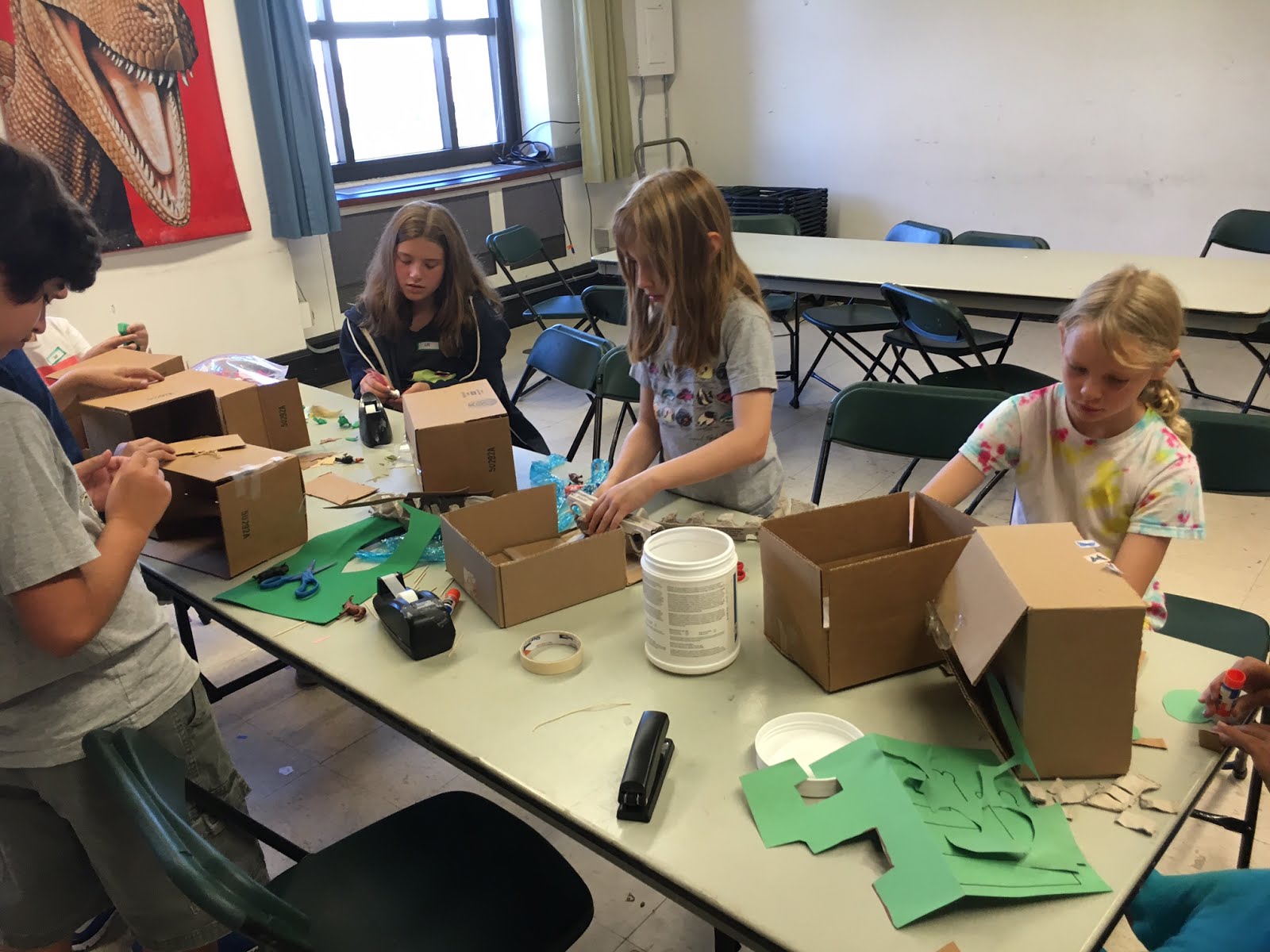
A camper makes their dinosaur exhibit diorama
Campers dig for dinosaur skeletons
A camper makes their dinosaur exhibit diorama


We hope your campers enjoyed learning about prehistoric life and how paleontologists study it this week. We know we had fun exploring with them! Next week is our last week of Camp Explorations for the summer, and we will be finishing it off with two exciting sessions: Outdoor Explorers in the morning and Best of Camp Explorations in the afternoon. We also have our last Little Explorers session, Science Explorers. We hope to see some of you again next week or next summer!

Natural Science Extravaganza

This week, the campers learned all about nature during Natural Science Extravaganza in the morning!

Campers play Quick-Frozen Critters outside!


 On Monday, the campers became zoologists and learned all about different kinds of animals.  They played a guessing game, where they had to look at pictures and use context clues to guess the animal! What do the number 5, a picture of a beach, a photo of the stars, and a close up of a fish have in common? You guessed it - starfish! The campers then made habitat dioramas where they used craft items to make a habitat suitable for their plastic animal! 

Campers create their animal habitats
The campers then learned about taxonomy and the classification of animals.  They pick an animal, and then with the help of their counselors they looked up the taxonomy of that animal. Finally, they ended the day with a game outside called Quick-Frozen Critters.  Some of the campers were prey animals, and others were predators.  The campers learned skills that each animal uses in the wild to survive!


Campers show off their "moose" structure


Tuesday was our day to travel to Nichols Arboretum where the campers learned about ecology.  The campers got to walk through trails in the Arb and observe the wildlife, both plants and animals. We even saw a few deer walking around!  The campers also had a blast building fairy homes for the Arboretum's fairy population. Then, after a snack in the Arb, the counselors read the campers a story about a girl who turns into various animals in the forest.  She explores the forest from the perspective of each animal, revealing how different the forest looks to each critter.  Finally, after a quick stop at the Huron River, the campers walked back to the Museum, where a freeze pop treat was waiting for them!


A camper measures a penny using
calipers made at camp
Campers listen as their counselor tell them
about looting at archaeological sites
Wednesday was all about Archaeology.  The campers learned about the tools archaeologists use, and about what kind of work they do. Then the campers were shown a map of an archaeological site and tried to figure out what the site might have been used for.  Then we told the campers that some items in the site had been stolen by looters, and showed them what the original site looked like.  The campers learned how looters can change the way that archaeologists view a site, and how damaging looters can be to the preservation of historical sites!  Then the campers took a dive into Lake Ontario and discovered the sunken remains of the SS Edmund Fitzgerald.  They made maps of what they saw, and took note in what artifacts they found at the bottom of the lake.  They also learned about the history of this ship wreck, which is the most famous of all ship wrecks on the Great Lakes!
Campers sketch a map of the SS Fitzgerald shipwreck in their journals!


A camper works on drawing a really complex maze!


 On Thursday, the campers reached for the stars, and learn all about Astronomy.  The campers made mazes on paper plates, and then used magnets on popsicle sticks to move a spaceship with a magnet through their maze! Campers then got to play the game PLANETS the Game, where they traveled through the solar system to various planets, and even got abducted by aliens!  By using the shadow from the sun, the campers learned about how the Moon rotates, even thought we
Another camper demonstrates how to use the magnetic
spaceship on his maze!
on Earth only see the same side of the moon. Finally, the campers headed to the Museum's planetarium for a show guided by orange groups counselor!  The campers learned about the constellations in the night sky, and what they might see right now in their own backyards.  To end the planetarium show, the campers flew into a simulation of what a black hole might look like!


A camper smiles as her pop-up triceratops stomps
through the forest


Campers play a quick game of clever catch!
On Friday, the campers became paleontologists and learned about prehistoric animals!  The campers had a quick tour of the Museum's dinosaur floor, and got to see some hands on items!  Later, the campers to assemble a mysterious animal puzzle, and try to figure out what kind of animal it is that they found. After, the campers made prehistoric pop-up cards.  We had a pre-made triceratops for campers to color in, but some creative campers made their own dinosaurs! Finally, the campers got to use some of the tools that paleontologists use, and searched for fossil remains in our sand dig box.  The campers gridded the site, and then searched for fossils.  They even got to keep their favorite fossil find!

Campers search for fossils in our
dinosaur sand dig box!

Dinosaur Explorers

We had a blast at our Dinosaur Explorers camp this week!

On Monday, we learned what are dinosaurs.  There are 4 rules to be a dinosaur.  
1. Dinosaurs do not live in the ocean or water. 
2. Dinosaurs cannot fly.
3. Dinosaurs do not do funny pushups. 
4. Dinosaurs do not have hair or fur. 

We talked about the 4 rules and each camper had a dinosaur or dinosaur friend.  We sorted them into 2 groups and put the dinosaurs on one felt board and the dinosaur friends (non-dinosaurs) onto another felt board. 


We learned that dinosaurs hatch out of eggs.  We made a dinosaur hatching egg craft.  


We also used vinegar to squirt on baking soda dinosaur eggs to find a surprise inside...a dinosaur!


A dinosaur was inside!


We also played a game of Dinosaur Says when we were outside at snack. 


Sauropods were herbivores!
On Tuesday, we learned about herbivore and carnivore dinosaurs.  We went and looked at different dinosaur teeth in the Museum exhibits.  Sharp, pointy teeth means it ate meat and more flat teeth means it ate plants. We also learned how to tell the difference between a tooth and a claw.  If it has a line in it (for a blood vessel), it's a claw not a tooth! We made ferocious T. rex hats to wear and painted a cast of our own T. rex tooth.  


On Wednesday, we learned about dinosaur footprints.  We looked at the fossil footprints in the Museum and also went outside and found out that some dinosaurs had left footprints outside!


We made our own dinosaur trackway stamp art.  


We also looked at the different sizes of dinosaurs and saw that some were REALLY big and some were pretty small!


On Thursday, we learned all about paleontologists.  We learned what tools Pete and Paula need to go on a dig.


We made our own Paleontologists hats and then went on a fossil dig.  We found dinosaur bones!

Searching carefully for fossils


A fossil!


Playing with dinosaurs
On Friday, we learned about fossils.  A fossil is something that is not alive anymore and is what is left of a dinosaur or another animal or plant. The only thing we have left of the dinosaurs are fossils.  We made our own dinosaur skeletons out of paper tubes.  We also got to play with some fossil play doh and made different dinosaur shapes.
Building a dinosaur skeleton
A Stegosaurus 


As we were reading the book Bones, Bones Dinosaur Bones by Byron Barton, we heard a knock on the door.  A paleontologist left us a package of fossils to look at. 
A paleontologist left us a package!


A mastodon tooth
Dinosaur Skin Impression
Sauropod Dinosaur Skin Impression


And put together our own dinosaur skeleton craft.
Putting together the dinosaur skeleton
A museum exhibit around the dinosaur